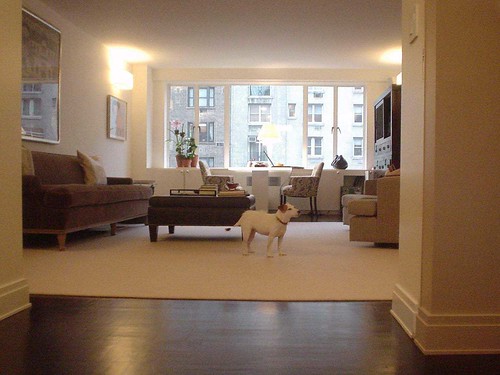
 I was asked to write a post about how the size of a dog isn't relative to the size of its living space. I decided to write all about apartment dogs. My opinion? There's nothing wrong with keeping a dog in an apartment - so long as (like with any living situation) you do your homework!
First off, I'm sure you know to check with your landlord and all that. You might want to run the breed you'd like past him/her, too. While you may not agree with them if they're uncomfortable with "bully" breeds, your landlord can still give you boot or make you give up your dog, and nobody wants that to happen. Respect his/her feedback. Secondly, figure out an action plan. Do you have a nearby park or place to exercise your dog every day? Do you know how he's going to relieve himself? Are you ready for the possibility of your dog making noise or picking up other habits that might annoy the neighbours?
But most importantly of all, have a breed in mind, and research research research!
Going to a shelter could also be a good idea. The people who work there have a good idea of what their dogs behave like, and might be able to pair you up with a suitable pooch. That way, you'll get an already polite and housebroken companion with a new lease on life. Win-win! If you do want a puppy to raise, though, think HARD on breed selection. I looked up some outside sources for help, and ... nearly every article was actually way off the mark when it came to some things. This one recommends Weimaraners, that one recommends Malamutes, here's one that recommends BEAGLES, as in named-for-baying BEAGLES - it's just a big headache. Let's start with the dogs we should AVOID.
The possibilities seem infinite. Gundogs and hounds are a noisy bunch, so you'll want to stay away from them. Even the barkless Basenji will yodel. Oh, and I think spitzes may own the title for Most Strident Voice in the dog world. Working/herding dogs have busy paws and busier minds, and they will wreak havoc on a small space if bored. Terriers might seem good for apartment living, but remember that these dogs were largely bred to a) investigate nooks and crannies, and b) run and find out. If something's happening on the other side of the wall, the curiosity may drive your terrier crazy. Sporting dogs are bouncy, exciteable and active. Faced with all these dead ends, I thought of Golden retrievers, the canine all-rounder, but then remembered that they can suffer from separation anxiety which can lead to destructive or noisy habits, oh my God, WHERE ARE ALL THE APARTMENT DOGS AT?
This site was my favourite of all the ones I looked at, because it's good for basically ball-parking things for you. It's a list of 50 most popular apartment dogs, but that doesn't mean that they all make GOOD apartment dogs, which the writer points out. It makes for a good estimation: if you check all your facts, one of these breeds could work well for you.
In picking your dog, generally check for three things: noise level, exercise requirement, and aggression factor. Remember that you and your dog will be sharing living space with other people. You're not the only one who has to get along with your dog.
Now here's a handful of breeds I can think to recommend.
THE GIANTS: You might be surprised to hear that the giants actually do quite well in apartments! Which brings us back to the original topic: big dogs do not necessarily need big plots of land to be happy. In fact, big dogs are some of the biggest couch potatoes in the dog world. I've mentioned Great Danes before now - those guys are quite happy to contort themselves into a happy pretzel and doze on the couch. And Newfoundlands, the sweet-tempered lovechild of a grizzly and a gorilla, used to spend most of their time hanging out on boats, and will do fine in an apartment provided they get their daily walk.
Things to consider: Naysayers will give you grief about cooping up such a big dog, and that may get wearying. Some people find it difficult to swallow that the dog doesn't require a huge house and yard. In actuality, your dog would probably just laze around some other six cubic foot space if you moved. The giant breeds are not the ones who will run laps around your home like they're chasing hubcaps at the Indiana 500: no, those are the small dogs!
Also, giants may not typically be big barkers, but when they do bark, they can bring the ceiling down. And you'll have to be quick to the draw on training your dog out of spurts of hyperactivity while it's small, especially when people come to the apartment, because if your giant starts a happy dance it might cave the floor in. (This is always something to consider with a giant, though. My cousin and her husband have a massive, soft-hearted Great Dane who greets people not by dancing but by putting his face in theirs to examine them from an inch away. His tail is going a mile a minute, but it can still be alarming. And they think this is okay, because he's not jumping!)
My real warning is that large dogs are prone to arthritis and displasia, so be mindful of the type of building you live in. Are you on one of the lower levels? Do you have to climb flights of stairs up to your apartment, or take an elevator? It may not seem important while your dog is young, but it could cause them grief later on in life.
Oh, yeah - and don't forget about the walking disaster that is a Dane's wagging tail!
THE TOYS: The ankle-biter brigade isn't for everyone, but trust me, if they were good enough for royalty, they're good enough for you. :) Just check if your breed of choice was originally bred to be a pet (like the Pekingese), or an active working dog (like the Yorkie), because this may make a difference.
Personally I'd recommend dogs from the Bichon family, because .... I like small white fluffy dogs. I feel ashamed every time I say it. But look into Malteses, Havaneses sound especially delightful, and Bichon frisés and the adorable Bologneses are promoted as low-shedding. And I won't lie: I like Chihuahuas, too. Honest! But if you get a Chihuahua, make sure you know exactly what you're getting into. I don't know what most owners expect, but Chihuahuas CAN be high-strung and they are by and large one-person dogs, and I think it's the owners who aren't prepared for that and don't socialize their dogs right that give Chis a bad rap! Papillons are another small breed I'm fond of, and they make very pleasant companions; just know that they are quite physically active. And the King Charles Spaniel makes for a very sweet-tempered lap dog.
Lastly, for those who prefer not to sit on either extreme end of the scale, some medium-sized dogs suited to apartment life:
ENGLISH BULLDOG: Friendly, squishy, stubby-limbed, bricked-in-the-face face, what's not to love! These guys are sweethearts AND they're easily trained.
SHAR PEI: Cutest puppies ever, plus these dogs are affectionate and, a bonus, very quiet.
CHOW CHOW: For those who know their way around a dog. Mostly bred as companions these days, they can be a bit willful, but they love their people.
GREYHOUND: You might be surprised, but it's true! In fact, one of the best apartment roomies you'll find is a retired greyhound. Most dogs retire at 3-4, but some will be 2 or younger. They get along with everyone, kids, grandparents and other pets included, and they are little couch potatoes. They're laidback, clean, relaxed, and low-maintenance. You can't ask for a better apartment dog.
STANDARD SCHNAUZER: Recommended by An American in Copenhagen - these guys are also for the dog-savvy, but they're very healthy, trainable, shed very little, don't bark much, and make great family dogs. They're also highly adaptable - and they're calm enough that some are used as therapy dogs. If you've got the time to exercise this robust little dog, he'll make another perfect roomie.
And, before I stop, yes, designer dogs can fare well in apartments too, I'm sure. As long as you're looking for a responsible breeder, I won't tell you not to buy one! Just REMEMBER that you don't always know what you're getting with a muttpuppy. Remember the puggle: Pugs aren't big barkers, but beagles ARE, so it's a bit of a risk to take one home (though training in puppyhood will help). With a designer dog, you've always got to do double the research!
I guess that's all for today. If you've got a breed to add, or if you think my information is wrong, please tell me! I'd like to have a relatively reliable list here. Thanks!
